Twelve different engines.
Not one.
Acne isn't dryness. Hormonal cycles aren't travel skin stress. So why would one scoring system serve all of them? Each Skin Map runs on its own mathematical engine — different formulas, different weights, different signals. This page shows you all twelve, with the actual function names from the codebase.
A generic "skin score" is fast to build but scientifically dishonest. The signals that explain oily breakouts are not the signals that explain cabin-air dehydration on a long-haul flight, and neither overlap meaningfully with cyclical hormonal flares. So we built twelve focused engines instead of one blurry one — each tuned to a specific question, each transparent enough that you can see the math, each producing a report that actually answers your question.
The shared 4-step pattern
What every map does share is the high-level shape: input → engine → report → next step. The engines themselves are completely different.
Input
You answer 15–30 quiz questions per map. Each question is a science-backed signal: sleep, sebum, climate, sensitivity, hormones, behavior.
Map-specific engine
Your answers run through that map's own scoring logic — different formulas, different weights, different signals. Acne ≠ Dryness ≠ Hormone.
Personalized report
We turn the math into a readable story: hero score, sub-scores, why-this-matters panels, and a recovery curve where relevant.
Connected next step
Each report routes you to the most relevant Skin Map next, so the system grows with you instead of restarting every time.
The twelve engines, in detail
Each card below shows the actual scoring logic from the codebase — function names, weights, and outputs. This is the math, not marketing copy.
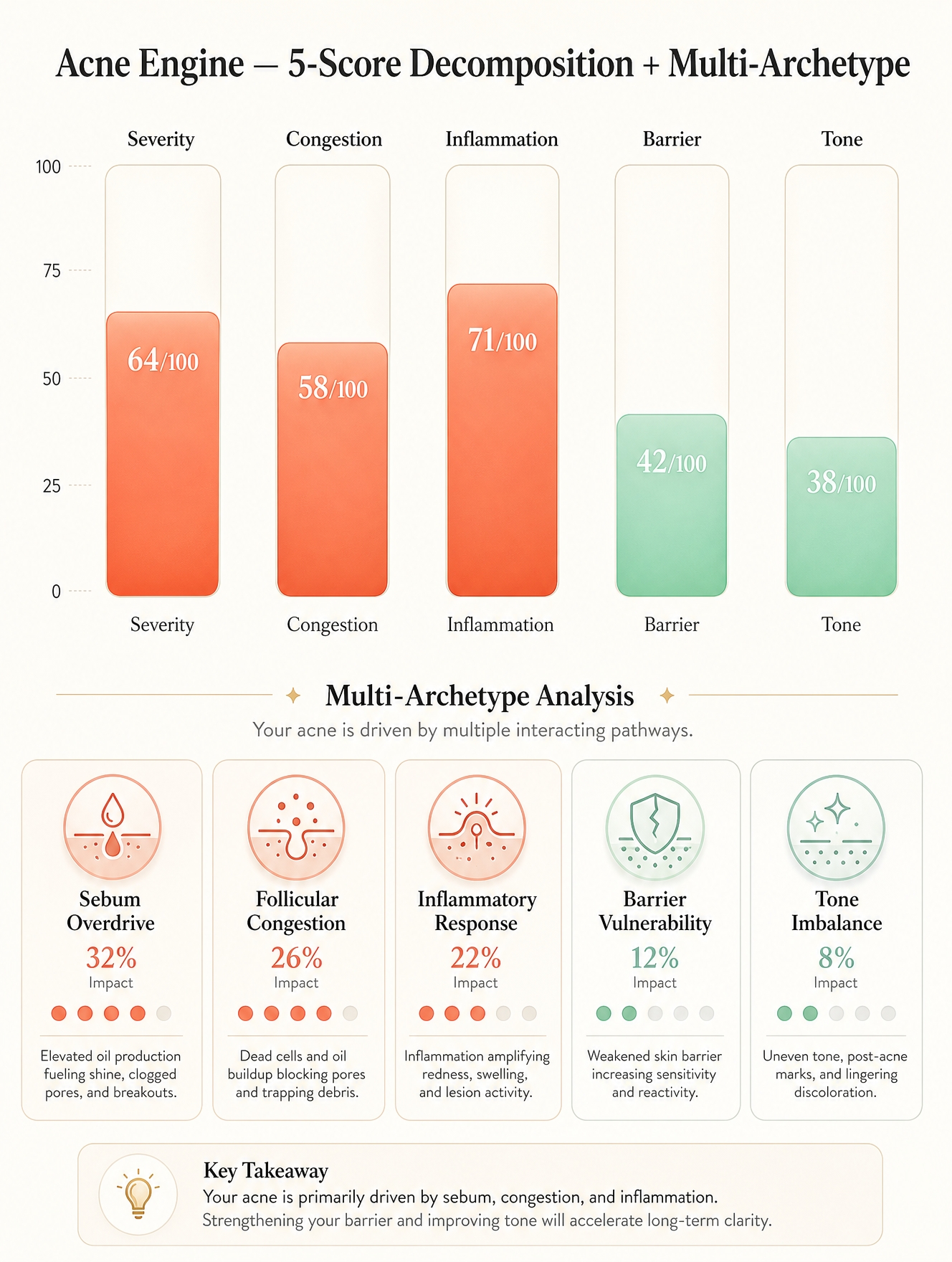
Acne Engine
Breaks acne down into five separate problems instead of one number
Most acne quizzes give you one severity number and call it a day. This engine separates acne into five things that matter independently: how bad it is right now, how clogged your pores are, how inflamed your skin is, how stressed your barrier is, and how your marks heal afterwards.
You can also pick up to three acne patterns in the quiz — for example, clogged pores + hormonal jawline + dark marks left behind. The engine weights them in order, so your first pick counts more than your third. Real skin almost never fits one tidy box, so the math doesn't pretend it does.
The engine also reads the difference between red marks and brown marks (they need different ingredients), and it adjusts expectations based on your skin tone — deeper skin tones are more prone to long-lasting brown marks, and the recommendations are tuned for that instead of pretending all skin behaves the same way.
Safety is baked in. If you're pregnant, breastfeeding, or on isotretinoin, the engine automatically filters out unsafe ingredients before recommending anything. If your acne is severe, painful, or cystic, you'll see a clear note suggesting a dermatologist visit instead of a routine.
The report gives you a step-by-step routine, an ingredients-to-look-for list, ingredients to skip, and a recovery timeline — based on dermatology research (AAD, NIH, Cochrane). It also points you to other Skin Maps when your answers suggest a hormonal, sensitivity, or pigmentation angle that this engine alone can't fully solve.
The Pro tier adds long-term tracking, early-warning alerts before flare-ups (cycle phase, sleep loss, post-workout), zone-tagged photo logging, and a clean PDF you can bring to your dermatologist.
5 sub-scores · pattern weighting · mark recovery guidance · routine sequence · ingredients to seek and avoid · clinical referral note when needed · cross-map suggestions · Pro tracker + flare alerts + PDF export
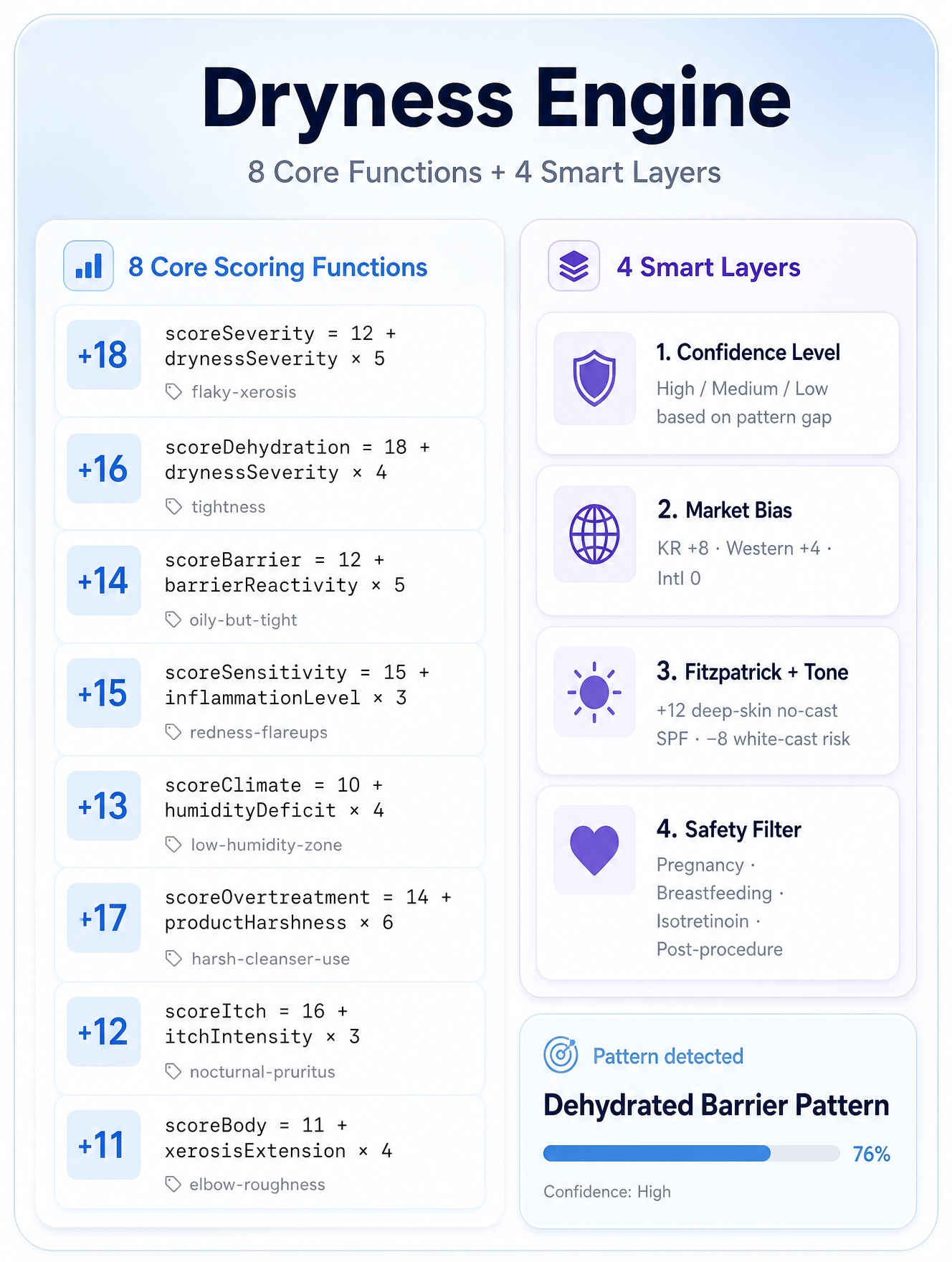
Dryness Engine
Eight transparent weighted functions — the most explainable engine
Dryness has the most transparent math of any engine in the system. Every score starts from a base value and adds explicit weighted increments for each signal you give it.
For example: scoreSeverity = 12 + drynessSeverity × 5, then +18 if pattern is flaky-xerosis, +16 if visible flaking, +12 if post-cleanse tightness. Nothing is hidden — you could rebuild your own score on paper if you wanted to.
8 sub-scores · pattern detection · ingredient highlights · projected recovery
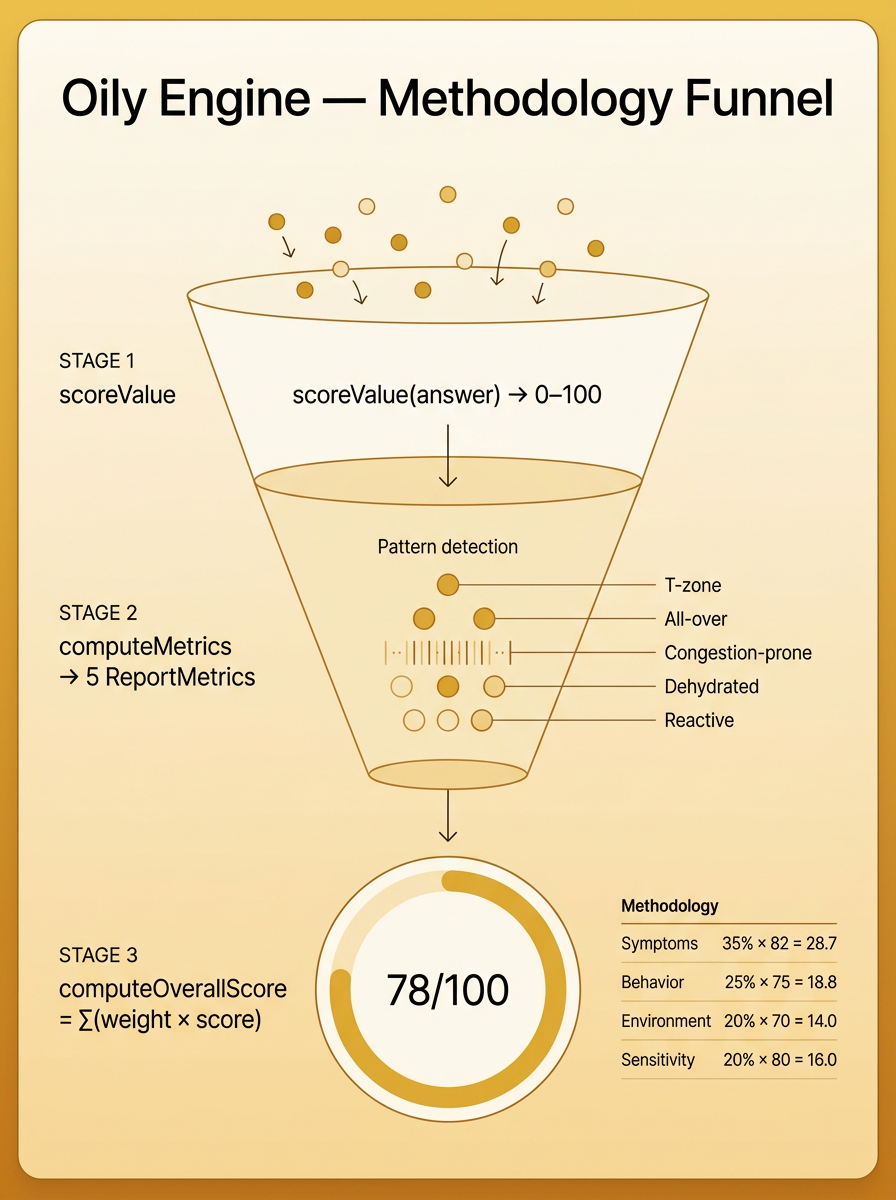
Oily Engine
A three-stage methodology funnel from raw answers to weighted total
The Oily engine flows through three sequential stages: each answer is first normalized to 0–100 by scoreValue, then aggregated into pattern metrics by computeMetrics, then summed against section weights (Symptoms, Behavior, Environment, Sensitivity) to produce a final overall score.
It detects five oily-skin patterns — T-zone, All-over, Congestion-prone, Dehydrated, Reactive — and shifts product weights based on which one wins.
5 metrics · pattern winner · methodology table · routine intensity
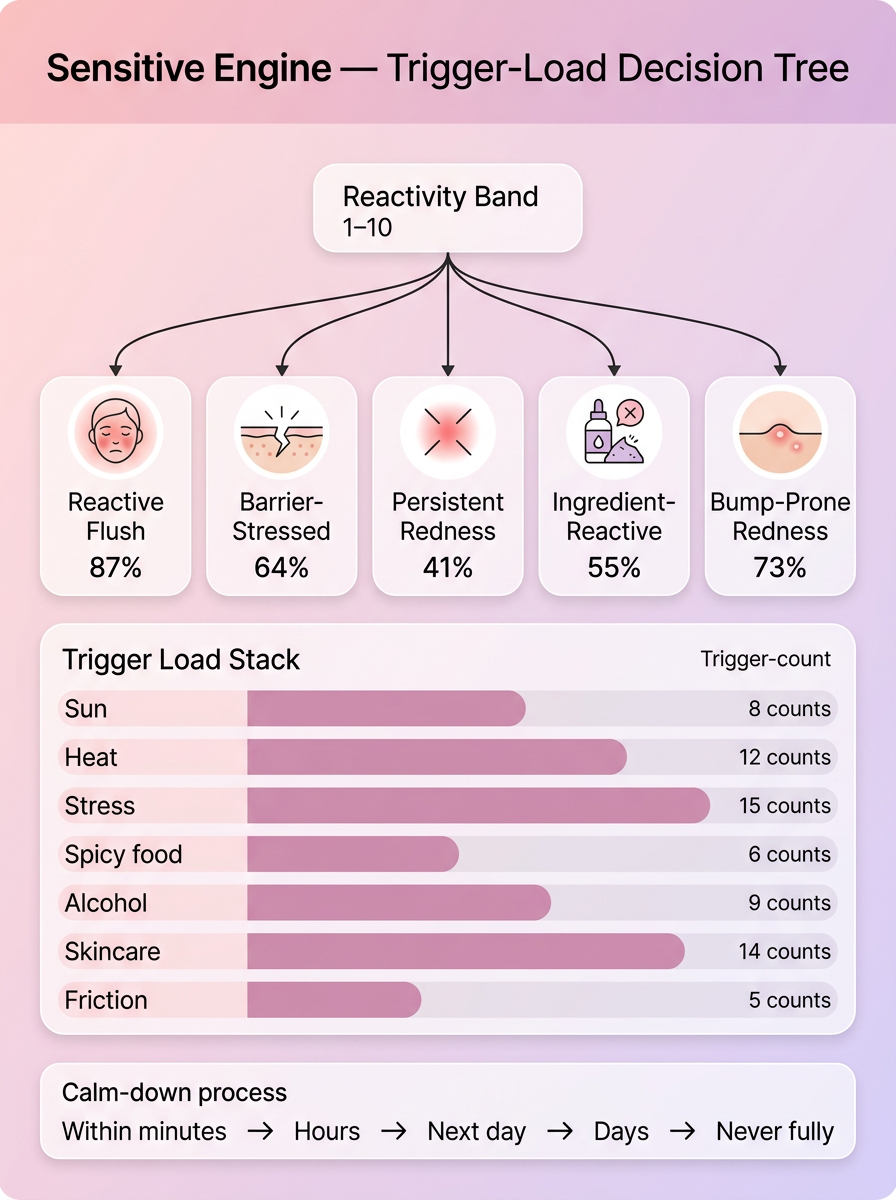
Sensitive Engine
A trigger-load × reactivity decision tree across five patterns
Sensitivity isn't one thing — it's at least five distinct patterns, and the engine has to pick which one is most likely yours: Reactive Flush, Barrier-Stressed, Persistent Redness, Ingredient-Reactive, or Bump-Prone Redness.
It does this by combining your reactivity band (1–10) with your trigger-load stack (sun, heat, stress, spicy food, alcohol, skincare, friction) and your calm-down timeline — anywhere from minutes to never-fully-resolved.
Pattern classification · trigger map · barrier-load score · calm routine
Hormone Engine
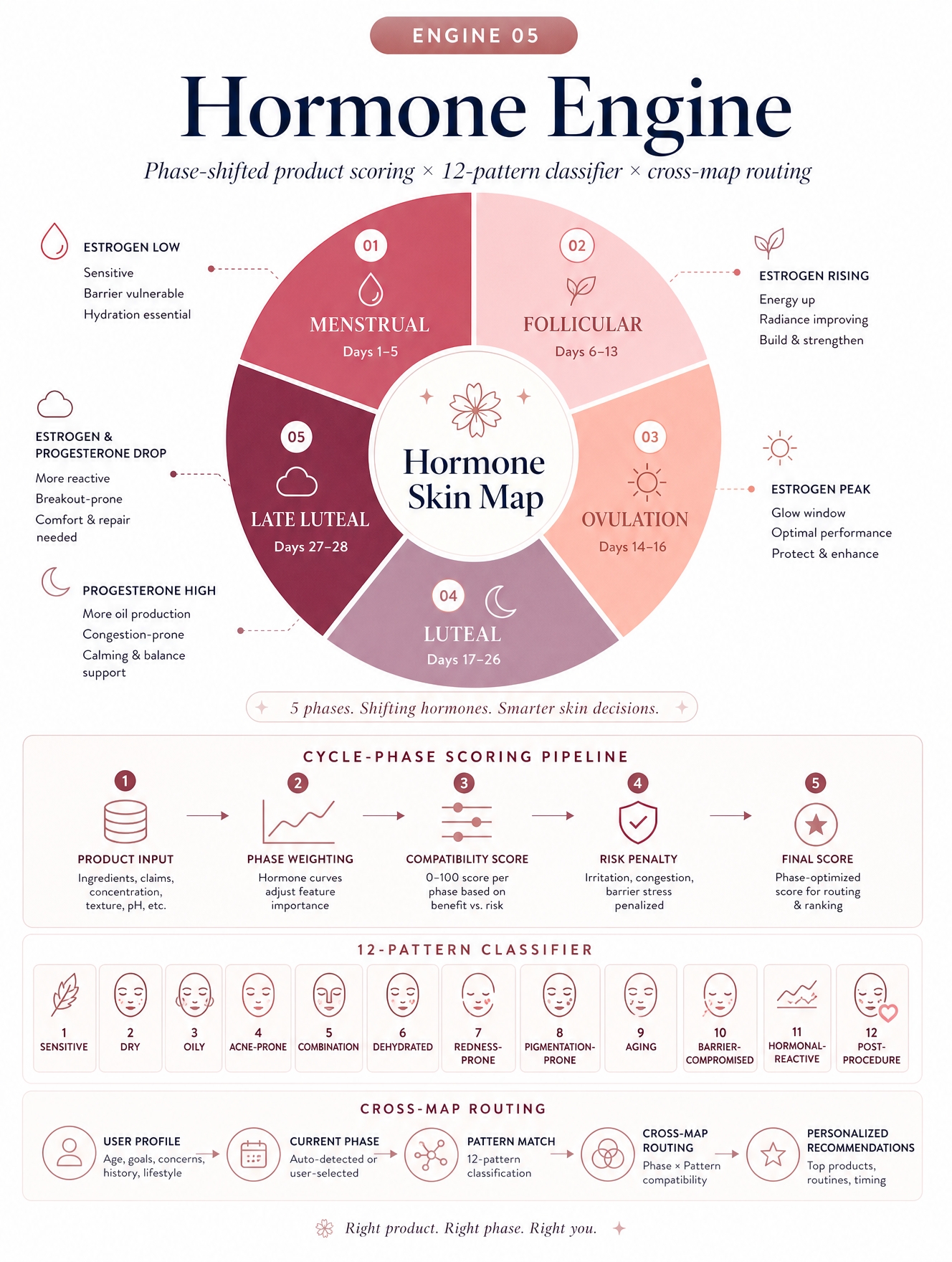
Reads your cycle, your medications, and your skin patterns together
Hormonal skin is different every week. The same person can have clear skin on day 8 and a cystic flare on day 24. Most quizzes ignore this. This one is built around it.
The engine adjusts product recommendations across five cycle phases — period, follicular, ovulation, luteal, and pre-period. It then matches you to one of twelve hormonal skin patterns, including hormonal melasma, PCOS-related breakouts, birth-control adjustment flares, post-isotretinoin recovery, and the classic cyclical chin-and-jaw acne.
It also reads your marks — red marks, brown marks, and melasma each need different ingredients, and the engine routes you to the right ones. If your answers point more strongly to acne, pigmentation, or sensitivity, the report sends you to those Skin Maps as a next step.
If the severity is high or symptoms suggest something a routine can't fix on its own (PCOS workup, melasma, persistent cystic acne), you'll see a clear note recommending a dermatologist or OB-GYN — not a longer ingredient list.
The Pro tier adds long-term cycle tracking that gets more accurate as you log entries (starting around 65% accuracy, climbing toward 95% after a month of logging), early alerts before flare-prone phases ("your late-luteal phase starts in 4 days"), and sync with Apple Health, Flo, and Clue.
12-pattern match · 5-phase routine · mark-type guidance · cross-map routing · clinical referral when needed · Pro tracker + predictive flare alerts + cycle app sync
Pigmentation Engine
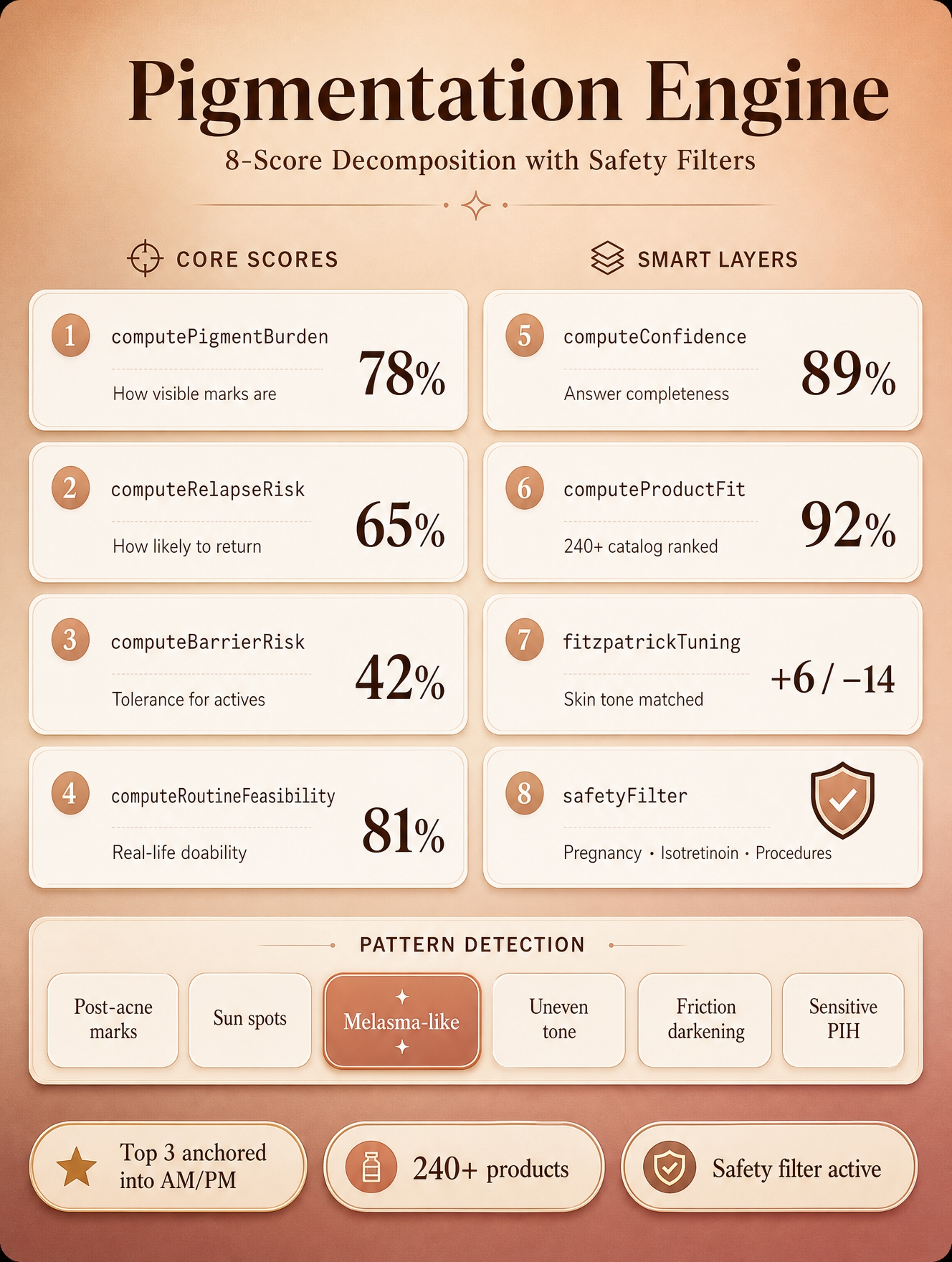
Seven independent risk and burden scores plus product-fit ranking
Pigmentation isn't just how dark the marks are — it's also how likely they are to come back, how stressed your barrier is, and whether your routine is realistically doable. The engine separates all of this into seven distinct scores.
Function names from the actual codebase: computeActiveIntensity, computePigmentBurdenScore, computeRelapseRiskScore, computeBarrierRiskScore, computeRoutineFeasibilityScore, computeConfidenceScore, computeProductFitScore.
7 sub-scores · color-tone matrix · pattern winner · gentle vs aggressive routine track
Beauty Engine
The only engine that scores how your makeup behaves — not whether your skin is sick
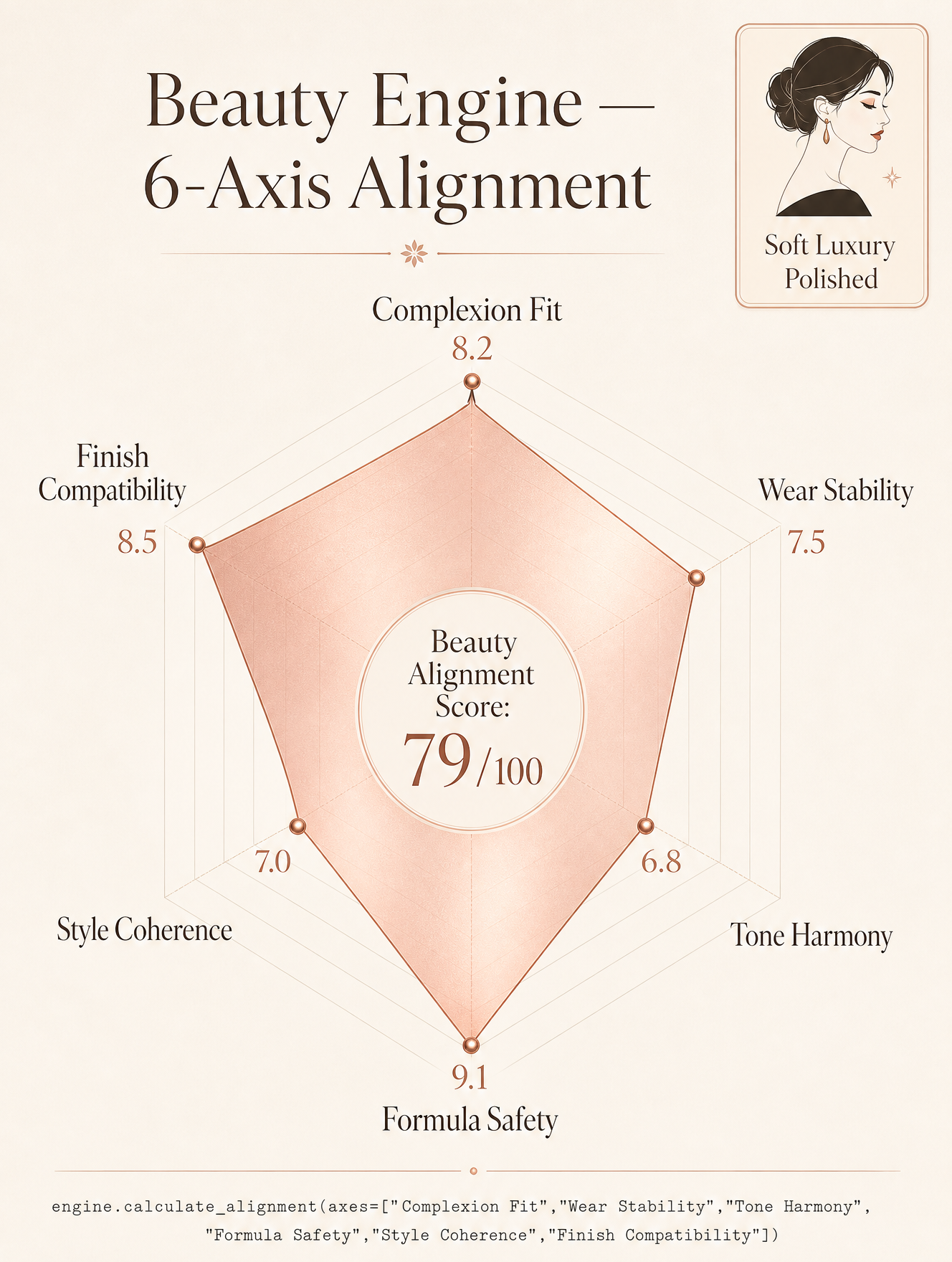
Beauty is the only engine that doesn't try to fix a skin problem. It answers a different question: why does my makeup never look the way I want it to? The reason is usually a mismatch between what you want (a finish, a vibe, a style) and what your skin actually does under that product.
The engine scores six things separately: how well a finish suits your skin behavior, how clearly your style sits in one identity, whether the finish you want is realistic for your climate, whether the look will hold through the day, how much corrective work the report has to do for tone or marks, and how safe a product is for your sensitivity and congestion risk. Each one is scored independently, then weighted into a single Beauty Alignment Score.
The engine reads your undertone (cool, warm, neutral, olive) and skin depth (Fitzpatrick I–VI), and it adjusts foundation matches based on both. For deeper skin tones, it automatically filters out SPFs and bases that cast white. Confidence is capped at 88% — the engine refuses to overpromise on aesthetics it can only estimate from a quiz.
Recommendations come from a catalog of around 100 products, filtered by your budget, your retailer (Sephora, Ulta, Olive Young, Amazon, official sites), your climate, and which features matter most to you. Your top priority counts more than your fifth, so the first thing you pick visibly shapes the result.
There's also an optional Facial Harmony module — if you opt in, you can pick a beauty standard (K-beauty, Western Golden Ratio, Soft Feminine, Sculpted Editorial, or Clean Natural), and the engine compares your self-described proportions against it. Results are directional, not diagnostic. For users 18+, the report can also show makeup-tricks, natural-exercise, and (for 25+) minimally-invasive or surgical paths — always with disclaimers and verification reminders.
The report also includes a seasonal forecast for free users: based on your region, it predicts the next major climate shift (summer humidity, winter dryness, monsoon, UV spike) and warns you before your makeup starts behaving differently.
The SkinCompass Pro tier adds an in-browser selfie shade-match (your photo never leaves your device), a photo log to track your skin over time, detailed climate-shift alerts with 14-day advance notifications, a multi-page PDF export of your report, and a polished shareable beauty card image.
Beauty Alignment Score · 6 sub-scores · profile card · 6-slot vanity capsule · top 3 star products · AM + post-makeup routines · ingredient guidance · seasonal climate alerts · cross-map routing · optional facial harmony + commitment paths · Pro selfie shade-match + photo log + PDF + shareable card
Lifestyle Engine
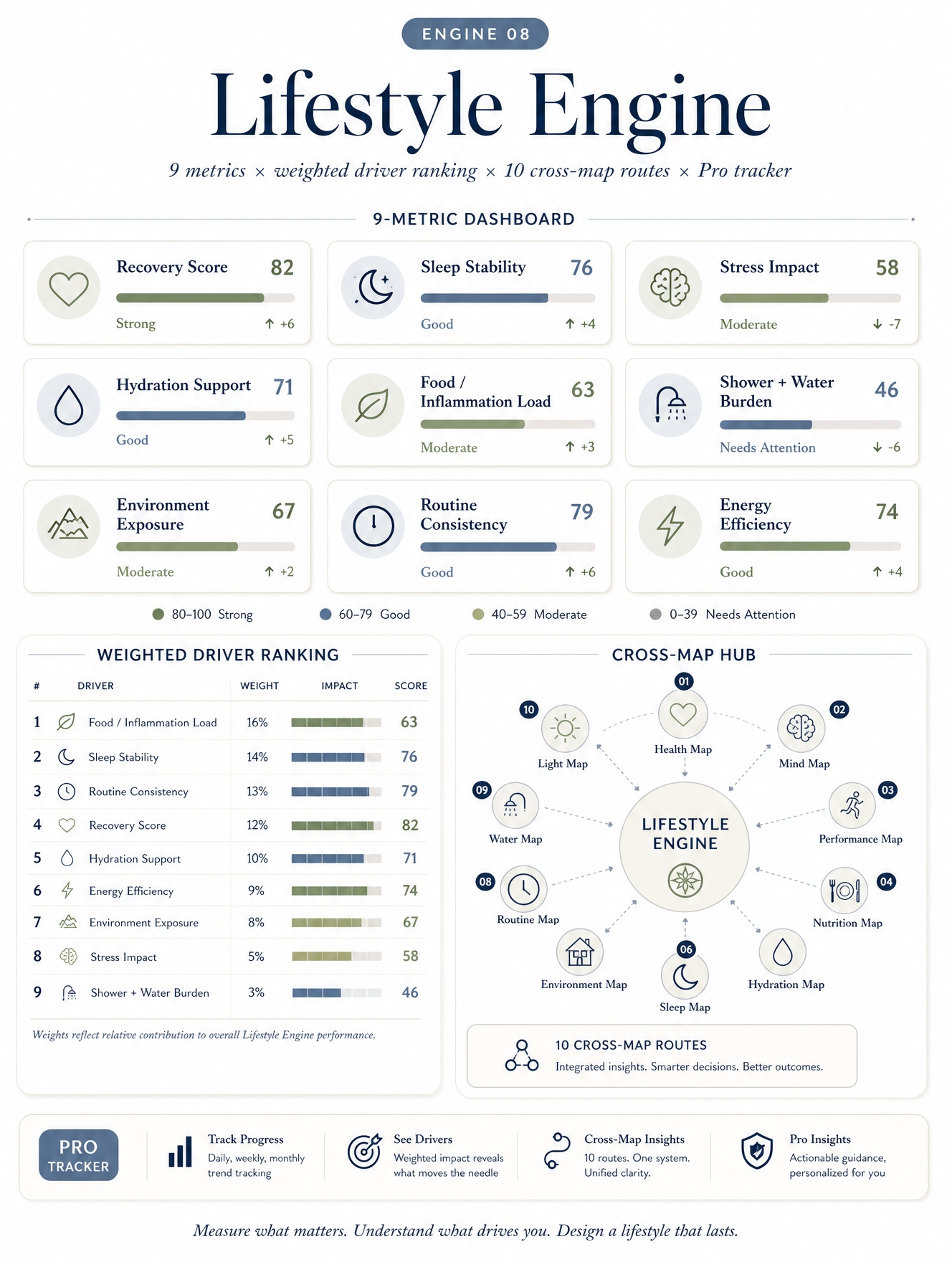
Turns daily habits into nine scored signals — and ranks which one is hurting your skin most
Lifestyle advice usually sounds like "sleep more, stress less, drink water". That's not actionable. This engine takes nine real signals — sleep, stress, hydration, food, showers and water hardness, indoor environment, routine consistency, recovery, and overall pressure — and scores each one against research-backed standards.
It then ranks which one is doing the most damage to your skin right now, using weights tuned to dermatology research: sleep and stress carry more weight than hydration or diet alone, because that's what the science actually shows. You get a clear answer about what to fix first, instead of a vague "work on everything."
Most people don't fit one clean lifestyle pattern, so the engine can show two profiles at once — for example, "Stress-Loaded" as your main pattern and "Heat + Hard Water" as a secondary one — when the answers point that way.
Lifestyle is the hub of the whole SkinCompass system. When your habits suggest hormone, acne, pigmentation, oily, dryness, food, travel, active, or K-Beauty context, the report routes you to those Skin Maps as your next step — so you keep building a fuller picture instead of running 12 isolated quizzes.
The Pro tier adds long-term tracking that gets more accurate the more you log, early alerts before low-sleep or high-stress weeks, sync with Apple Health, Oura, Whoop, and Google Fit, and a shareable PDF export.
9 scored signals · ranked drivers · primary + secondary profile · cross-map routing to 10 other maps · research-backed education · Pro tracker + alerts + device sync + PDF
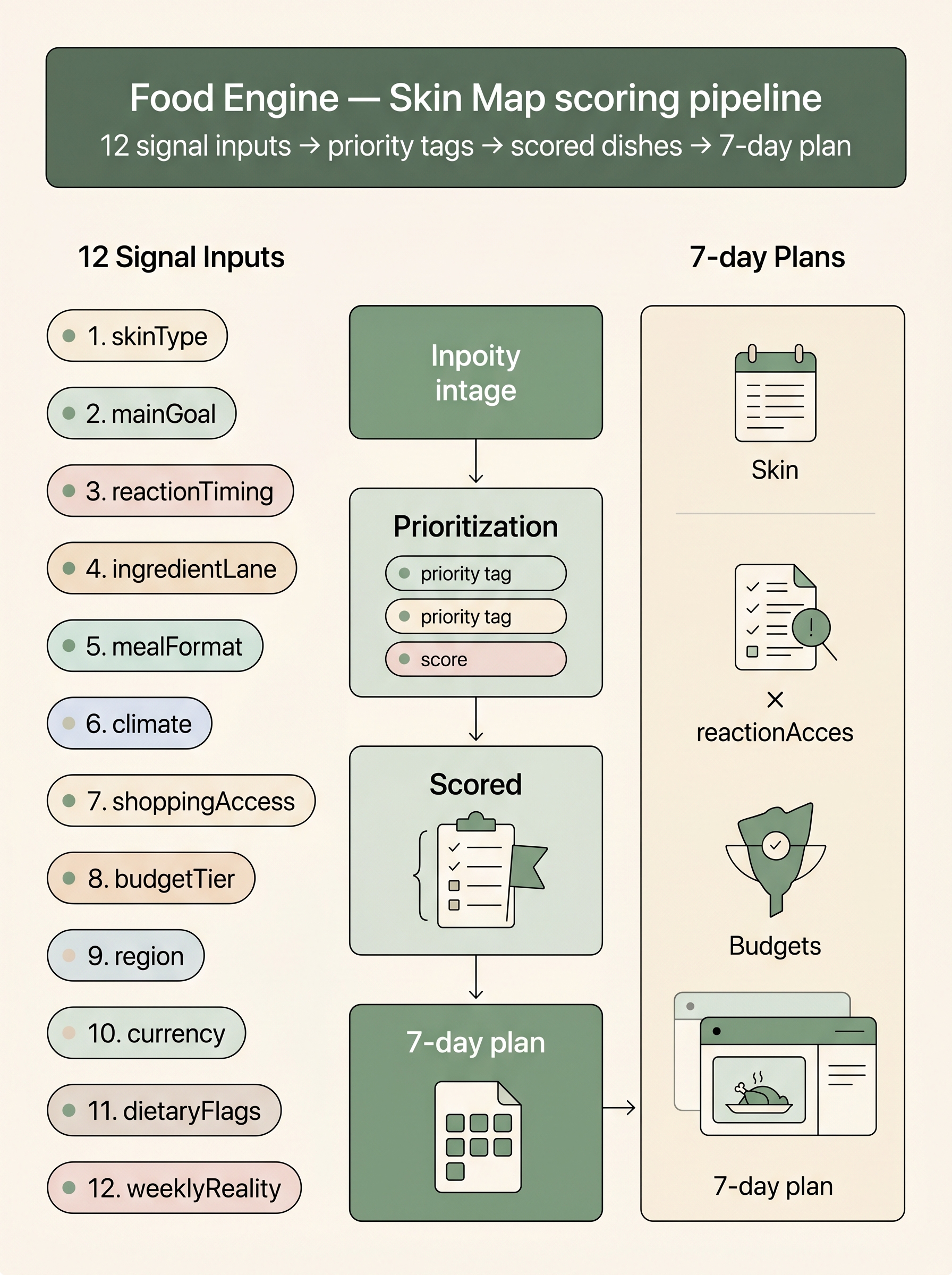
Food Engine
Matches real recipes to your skin goal, your budget, your region, and what you'll actually eat
Food is the only engine that doesn't score a problem — it scores real meals against your skin goal, what's available where you live, your budget, and your dietary rules.
Each main goal has its own priority list. Calming breakouts prioritizes cleaner, lighter, higher-protein meals. Fading marks leans into antioxidants and produce. Recipes are scored against those priorities, then filtered for your dietary flags (vegan, vegetarian, halal, kosher, gluten-free, dairy-free) and your allergies before anything is recommended.
Pricing is regional, not American by default. A salmon bowl in Seoul costs differently than one in New York, and the engine knows this. Prices are stored for the US, Canada, Europe, Korea, Japan, China, and India, and converted into your local currency using live exchange rates when the report loads.
You don't just get a list of "good foods" — you get a real 7-day meal plan with a grocery list priced in your currency, a weekly rhythm to follow, ingredient cards explaining why each one helps, and a watchout list for foods that may be triggering your specific pattern.
Top-matched dishes · ingredient cards explaining why · 7-day meal plan · grocery list priced in your currency · weekly rhythm · foods to watch · cross-map suggestions
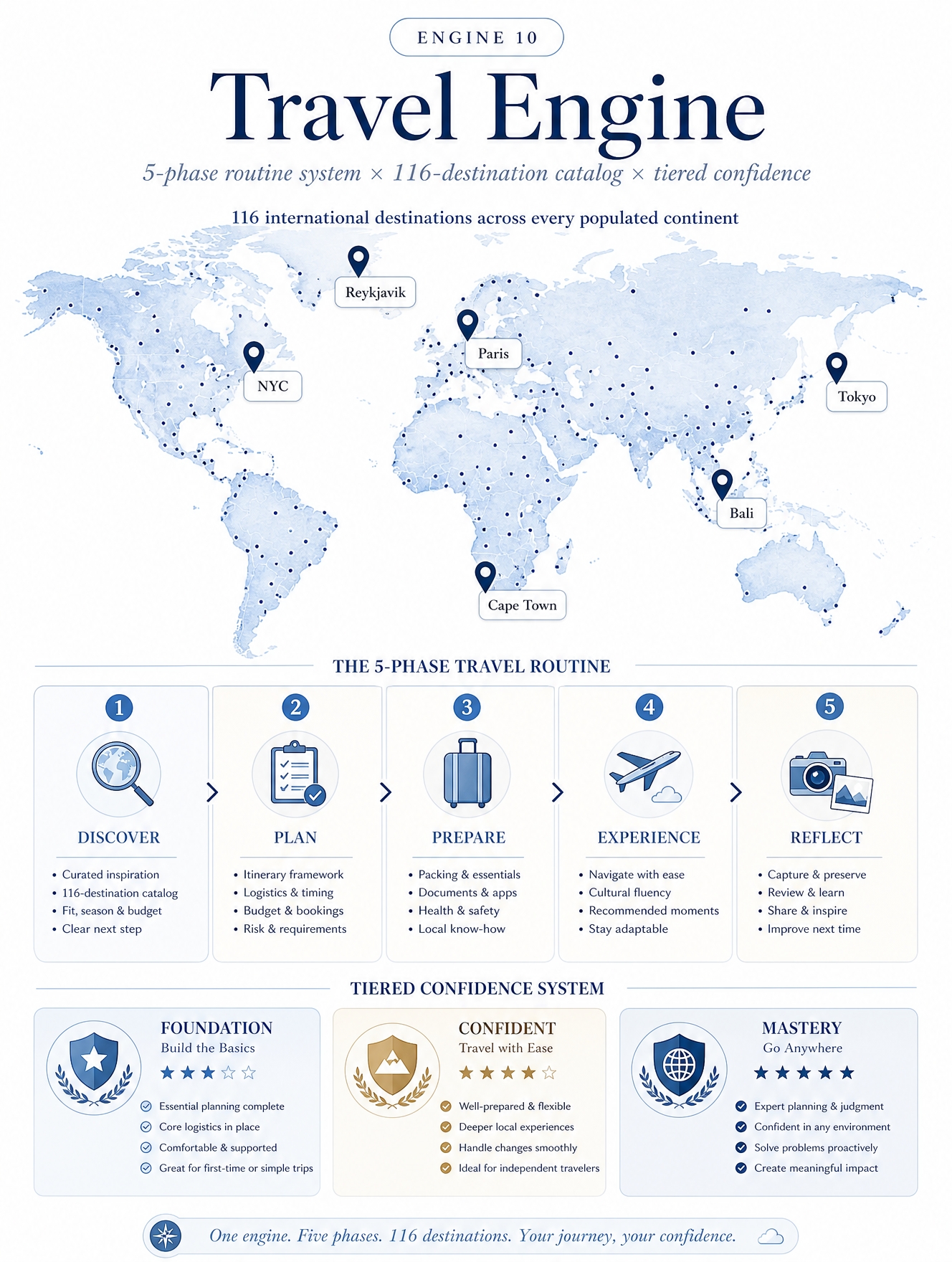
Travel Engine
Built for trips — where your skin changes by the hour and your routine has to adapt with it
Travel is the engine that handles the most moving parts in the system. On a trip, your skin is dealing with the climate you came from, the dry air on the plane, the new climate when you land, the UV, the hotel water, jet lag, and even unfamiliar food — all in 48 hours. One generic routine can't handle that.
The engine reads your origin and destination against a curated catalog of 116 cities across every continent, then builds a routine split into five phases: before boarding, in-flight, after landing, destination morning, and destination evening. Each phase asks different things of your skin, so it pulls different products.
On top of that it layers destination-aware details: dietary filtering (vegan / halal / kosher / gluten-free), medication safety (retinoid + strong sun = caution), accommodation guidance (hotel hard water vs. Japanese ryokan baths), automatic reef-safe SPF flagging for Hawaii, Mexico's Yucatán, and other reef destinations, plus a jet-lag plan with melatonin windows based on which direction you're flying.
Two of the most useful layers: cross-cultural food cautions (when your home cuisine plus the destination's cuisine creates a known flare combo) and heritage food bridges (when your background actually helps — a Korean traveler in Japan, for example, will tolerate a lot of the local food better than the average tourist). If you've used this Skin Map before, the engine recognizes you as a returning traveler and skips the basics.
Every report ends with a confidence score — high, medium, or low — based on how complete your inputs were, plus a visible breakdown of why. The system tells you when it's sure and when it's guessing.
5-phase routine · climate brief · jet-lag plan · pack list + buy-there list · food guide with cross-cultural notes · curated local + online shops · confidence score with reasoning · shareable PDF
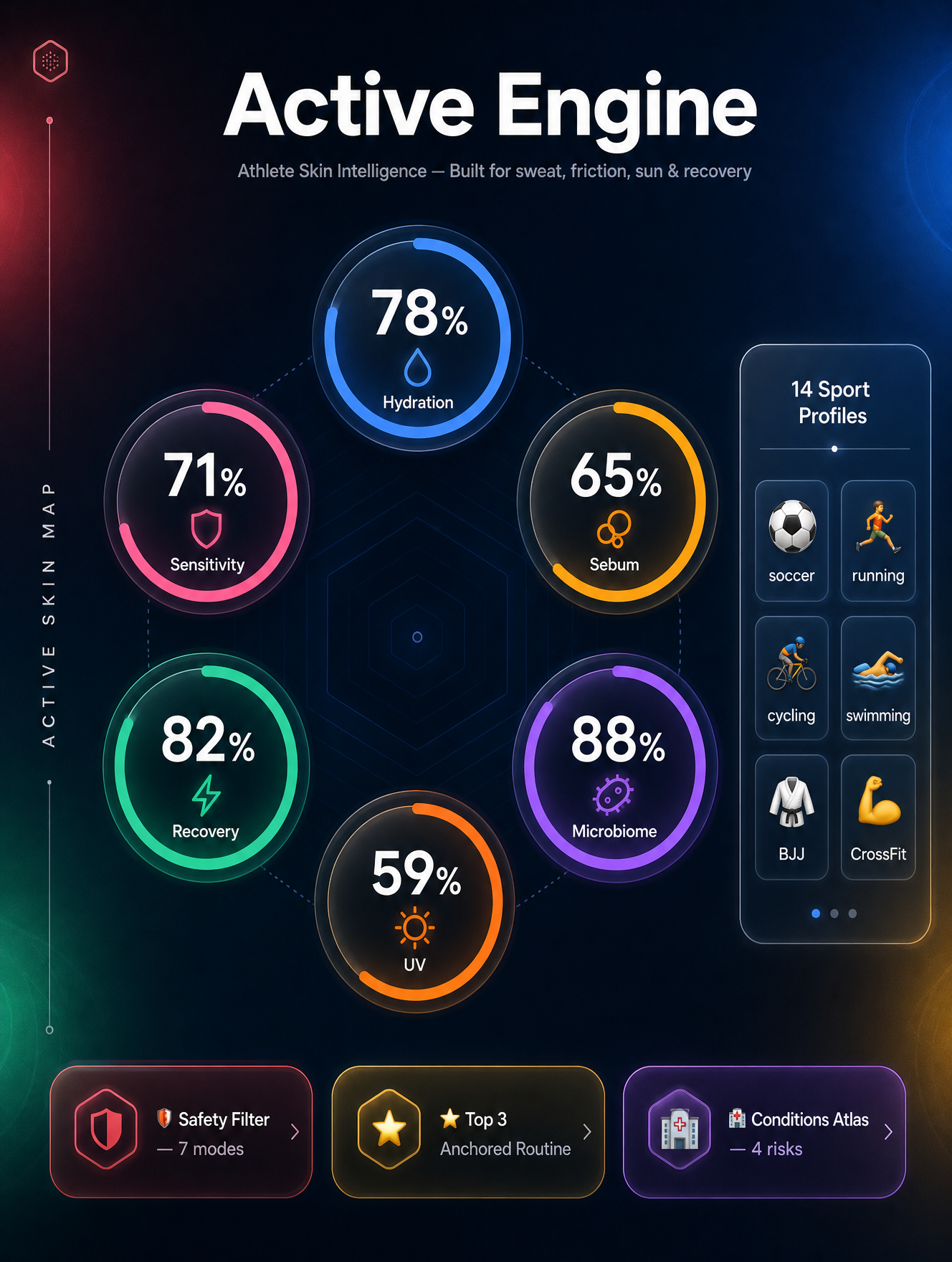
Active Engine
Six athlete-specific metrics anchored in the Baumann Skin Type Indicator
Active skin is different from regular skin — sweat changes pH, vasodilation changes redness, friction changes barrier integrity. The engine starts with the Baumann Skin Type Indicator (a 30-minute bare-face test + a 20-minute post-shower body test) and layers six athlete-specific metrics on top.
The six metrics: Hydration 💧, Sebum Control 🫧, Sensitivity 🛡️, Recovery ⚡, UV Protection ☀️, Microbiome 🦠. Each is grounded in clinical numbers: UV exposure rises 2–3× during outdoor exercise, SPF effectiveness drops 84% after 40 min of sweat, and skin bacteria multiply ×10 within 30 min of post-workout occlusion.
6-metric dashboard · pre/post-workout routines · supplement & ingredient stack · tracker
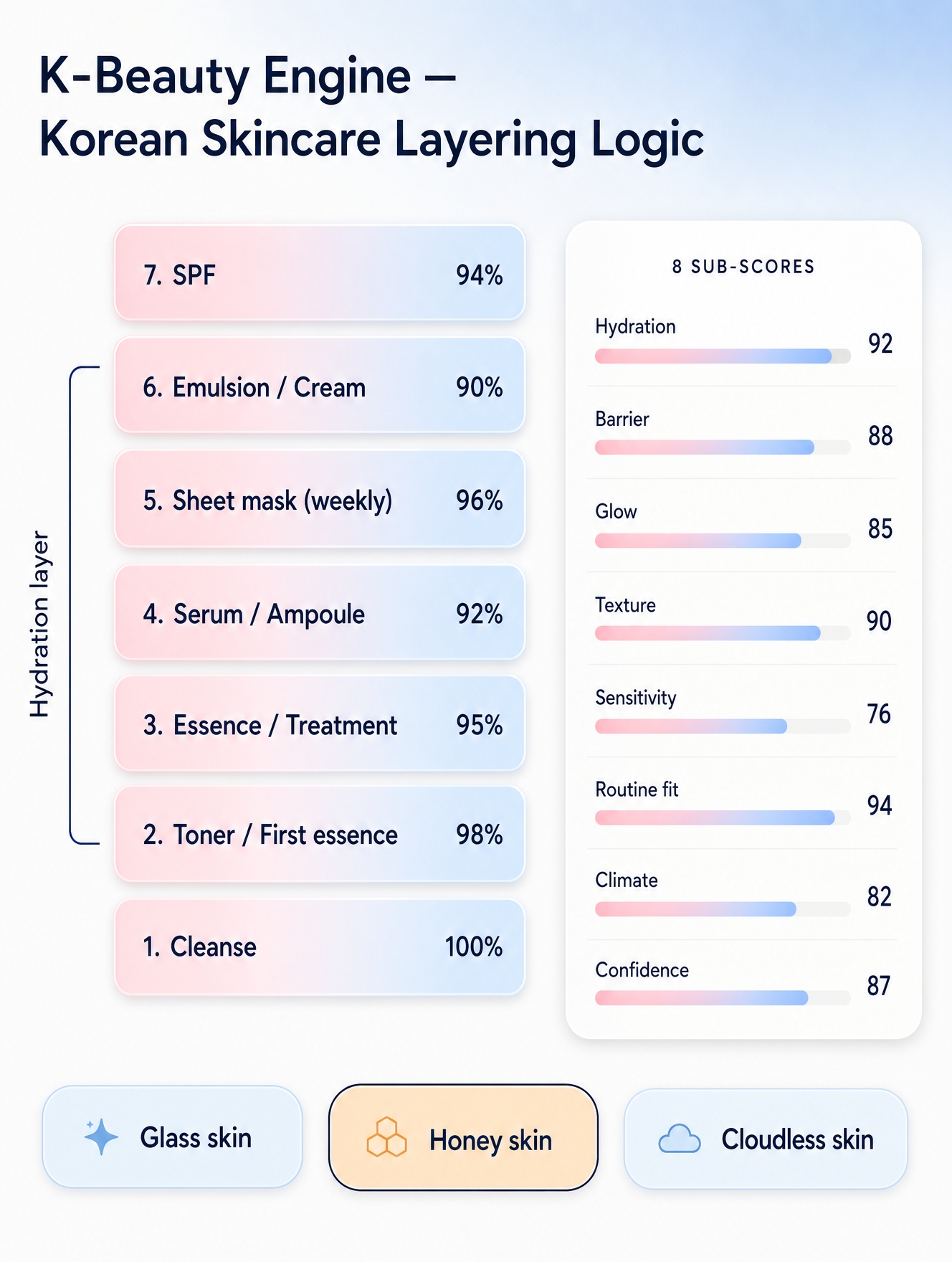
K-Beauty Engine
Seven-layer Korean skincare logic optimized for glass-skin clarity
The K-Beauty engine encodes the classic seven-layer Korean routine (cleanse → toner/first essence → essence → serum/ampoule → sheet mask → emulsion/cream → SPF) and scores each product against layer compatibility — does this serum sit well under that emulsion, does this cream pill under that SPF.
Output archetypes are finish-driven, not problem-driven: Glass skin, Honey skin, Cloudless skin. The engine optimizes for barrier-first hydration with K-beauty texture priorities.
Layered routine · archetype match · K-beauty product picks (Olive Young / YesStyle / StyleKorean)
Glossary — every term, in plain language
The vocabulary used across our quizzes and reports. If a word ever feels confusing inside a Skin Map, you'll find it explained here.
Skin barrier
The outermost protective layer of the skin. When it's healthy, water stays in and irritants stay out.
Stratum corneum
The very top layer of the skin barrier, made of dead skin cells held together by lipids. This is what most 'barrier care' actually targets.
Ceramides
Fat-like molecules that act as the 'mortar' between skin cells. Lower ceramide levels = more dryness, sensitivity, and irritation.
Sebum
The natural oil your skin produces. Too little leads to dryness; too much leads to oily, congested-feeling skin.
TEWL
Trans-Epidermal Water Loss. How fast water evaporates out of your skin. High TEWL = leaky barrier, faster dehydration.
Microbiome
The community of helpful microbes that live on your skin. A balanced microbiome helps calm inflammation and protect the barrier.
pH
A measure of acidity. Healthy skin sits around 4.5–5.5. Cleansers that are too alkaline can disrupt the barrier.
Skin baseline
Your skin's natural behavior with nothing applied: dry, oily, combination, normal, or sensitive.
Dehydrated vs dry skin
Dry skin lacks oil. Dehydrated skin lacks water. You can be oily and dehydrated at the same time.
Comedonal acne
Mostly clogged pores, whiteheads, blackheads. More texture than redness.
Whiteheads (closed comedones)
Clogged pores covered by a thin layer of skin. Bumpy but not red.
Blackheads (open comedones)
Clogged pores exposed to air, oxidizing dark.
Papules
Small red inflamed bumps without a visible head.
Pustules
Inflamed spots with a visible white or yellow center.
Nodular / cystic acne
Deep, painful, under-the-skin lumps. Slower to heal and more likely to scar.
Inflammatory acne
Acne dominated by redness, swelling, and active breakouts (vs just clogged pores).
Hormonal jawline acne
Breakouts that cluster around the chin and jawline and often follow a cyclical pattern.
PIH
Post-Inflammatory Hyperpigmentation. Brown or dark marks left after a breakout heals.
PIE
Post-Inflammatory Erythema. Red or pink marks left after a breakout, more common on lighter skin.
Reactive / barrier-stressed acne
Acne happening on skin that's also sensitive, flushed, or over-treated.
Post-cleanse tightness
That stripped feeling right after washing. Usually a sign the cleanser is too harsh or the barrier is already stressed.
Flaking / xerosis
Visible peeling or dry flakes on the skin surface.
Fine dehydration lines
Tiny crepe-like lines that appear when the skin is low on water (different from true wrinkles).
Reactivity
How easily your skin stings, burns, or flushes when products are applied.
Telangiectasia
Tiny visible blood vessels on the surface of the skin, often on the cheeks or around the nose.
Flushing
Sudden temporary redness, usually triggered by heat, stress, alcohol, or spicy food.
Vasodilation
When blood vessels widen. Causes the warmth and redness you feel after exercise, alcohol, or hot showers.
Hard water
Tap water high in minerals like calcium and magnesium. Can leave residue and stress the barrier.
Indoor heating / AC
Both lower indoor humidity, which speeds up dehydration.
High-glycemic load
Diets high in sugar and refined carbs that can drive inflammation and breakouts.
Gut-skin axis
The two-way connection between digestion and skin. Gut issues can show up as flares within 24–48 hours.
Occlusion
When something blocks the skin (mask, helmet, sweat, heavy product). Can trap heat and cause friction breakouts.
Friction acne (acne mechanica)
Breakouts caused by rubbing, pressure, or repeated contact (helmets, phones, masks).
Cabin-air dehydration
Airplane cabin humidity is around 10–20%, much drier than most homes. Skin loses water faster mid-flight.
Jet lag stress
Disrupted circadian rhythm affects cortisol, which affects oil, inflammation, and recovery.
Climate adaptation gap
When your skin is calibrated to one environment and you suddenly enter another (humid → dry, cold → tropical).
Retinoid / retinol / adapalene
Vitamin A derivatives that speed up skin cell turnover. Powerful but irritating if overused.
AHA
Water-soluble exfoliants like glycolic and lactic acid. Work on the skin surface. Help with dullness, texture, marks.
BHA (salicylic acid)
Oil-soluble exfoliant that goes inside the pore. Best for blackheads and oily skin.
PHA
A gentler, larger-molecule exfoliant. Better for sensitive skin.
Niacinamide
Form of vitamin B3. Calms redness, balances oil, supports the barrier.
Vitamin C
Antioxidant that brightens tone, fades marks, and helps protect against UV damage.
Azelaic acid
Calms redness, helps with acne and pigmentation. Generally well-tolerated by sensitive skin.
Tranexamic acid
Targets stubborn pigmentation, especially melasma.
Benzoyl peroxide
Strong anti-bacterial acne ingredient. Effective but can dry out and bleach fabrics.
Hyaluronic acid
A humectant that binds water to the skin. Hydrates without adding oil.
Severity score
Overall barrier or acne burden. Lower is better.
Congestion score
How much clogged-pore pressure your skin is showing. Lower is better.
Inflammation score
How active, red, and reactive the skin is right now. Lower is better.
Barrier score
How resilient your skin is. Higher is better.
Tone score
How well your skin recovers from marks and discoloration. Higher is better.
Confidence score
How strongly your quiz answers point to one clear pattern.
Match score
How well a recommended product fits your specific quiz answers.
Consistency score
Whether your routine and habits actually align with each other.
Recovery curve
A simple visual showing how clarity tends to build over weeks of consistency.
Rosacea
A long-term condition with persistent redness, flushing, and sometimes visible vessels or bumps. Different from acne.
Eczema / atopic dermatitis
Itchy, dry, inflamed patches caused by a mix of barrier weakness and immune reactivity.
Allergic contact dermatitis
A delayed allergic reaction to a specific ingredient (often fragrance, preservatives, or metals).
Melasma
Patchy, often symmetrical pigmentation, frequently triggered by hormones plus sun.
Glassy / glass-skin finish
The high-shine, dewy K-beauty look. Healthy-looking skin with a wet finish.
Satin finish
A middle ground: not flat-matte, not shiny. Soft polished glow.
Velvet / soft-matte finish
Smooth and powdery without looking dry or cakey.
Soft-focus
A blurring effect where pores and texture look softened rather than sharp.
Clean-girl polish
Minimal-makeup look that still reads 'put together' — usually relies on healthy underlying skin.
About this system
SkinCompass is an educational estimation system, not a clinical diagnostic tool. Each Skin Map's quiz is grounded in dermatology research, and every claim links back to its source inside the report. For medical concerns, please see a licensed dermatologist.
Start with the Barrier Assessment
It's the entry point of the system. After you finish, the platform will route you to the most relevant next Skin Map automatically.
Take the Barrier Assessment →